The Pistol formation in football strategically positions the quarterback a few yards behind the centre, creating an advantageous setup for both running and passing plays. This alignment not only enhances the quarterback’s decision-making but also facilitates effective run-pass options and misdirection tactics, allowing offences to adapt dynamically to defensive schemes.
What is the Pistol formation in football?
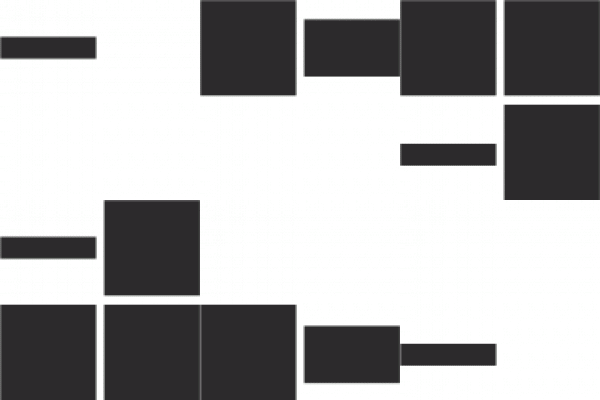
The Pistol formation in football is an offensive alignment that positions the quarterback a few yards behind the centre, with a running back directly behind him. This setup allows for a balanced attack, enabling both run and pass plays while maintaining flexibility in offensive strategies.
Definition and structure of the Pistol formation
The Pistol formation combines elements of the traditional shotgun and I-formation. In this setup, the quarterback stands approximately four to five yards behind the centre, with a running back positioned directly behind him. This arrangement creates a dynamic option for both running and passing plays.
Key structural elements include the quarterback’s depth, the alignment of the running back, and the positioning of wide receivers. The running back’s proximity to the quarterback allows for quick handoffs and effective play-action passes.
Historical context and evolution of the Pistol formation
The Pistol formation was popularized in the early 2000s by coaches such as Chris Ault at the University of Nevada. It emerged as a response to the evolving nature of defenses and the need for more versatile offensive schemes. Over the years, it has gained traction at various levels of play, including college and professional football.
As teams sought to maximize offensive efficiency, the Pistol formation provided a solution by blending the strengths of multiple formations. Its adaptability has allowed it to evolve, incorporating elements from spread offences and traditional running schemes.
Comparison with other offensive formations
When compared to the shotgun formation, the Pistol allows for a more balanced attack, as the running back’s position facilitates both run and pass options. In contrast, the shotgun often favours passing plays due to the quarterback’s deeper drop.
Compared to the I-formation, the Pistol offers greater flexibility in play selection. The I-formation typically emphasizes running plays, while the Pistol can effectively execute both runs and passes, making it harder for defenses to predict the offence’s intentions.
Strategic advantages of using the Pistol formation
The Pistol formation provides several strategic advantages, including improved deception and misdirection. The quarterback’s positioning allows for quick decision-making, enabling effective play-action passes that can catch defenses off guard.
Additionally, the formation enhances the running game by allowing the running back to read the defense’s alignment before making a cut. This can lead to more successful runs, as the running back has a better view of the field and can react accordingly.
Common teams and coaches utilizing the Pistol formation
Several notable teams and coaches have successfully implemented the Pistol formation. The University of Nevada, under Chris Ault, is credited with its initial development and popularization. Other teams, such as the Baltimore Ravens and San Francisco 49ers, have incorporated elements of the Pistol into their offensive strategies.
Coaches like Jim Harbaugh and Greg Roman have utilized the Pistol formation to maximize their players’ strengths, particularly in the running game. Its continued use across various levels of football demonstrates its effectiveness and adaptability in modern offensive schemes.
How does quarterback positioning affect the Pistol formation?
Quarterback positioning in the Pistol formation is crucial as it influences the effectiveness of offensive plays. Proper alignment allows for better decision-making and enhances the execution of run-pass options and misdirection tactics.
Optimal quarterback positioning in the Pistol formation
In the Pistol formation, the quarterback typically stands about three to four yards behind the centre. This positioning allows for a clear view of the defense and facilitates quick decision-making. The quarterback’s alignment should also consider the spacing between the offensive line and the running back, which is usually positioned directly behind him.
Adjusting the quarterback’s depth can impact the timing of plays. A deeper drop may provide better vision but can slow down the handoff or pass execution. Conversely, a shallower position can speed up the play but might limit the quarterback’s field of vision.
Impact of quarterback positioning on play execution
The quarterback’s position directly affects the spacing and timing of offensive plays. A well-positioned quarterback can quickly read the defense and make necessary adjustments, which is vital for successful execution. For example, if the defense shows blitz, a quick adjustment in positioning can help in executing a screen pass or a quick handoff.
Moreover, the quarterback’s alignment can influence the offensive line’s blocking schemes. When the quarterback is positioned correctly, it allows linemen to better anticipate their assignments, leading to improved protection and running lanes.
Quarterback decision-making processes in the Pistol formation
In the Pistol formation, the quarterback’s decision-making is heavily influenced by their positioning. A quarterback must quickly assess the defensive alignment and make split-second decisions on whether to hand off the ball, pass, or keep it. This requires a keen understanding of the defense’s tendencies and the ability to read their movements.
Effective decision-making also hinges on the quarterback’s vision. Being positioned behind the centre allows for a broader view of the field, enabling the quarterback to spot open receivers or potential gaps in the defense. This perspective is essential for executing plays that rely on misdirection or exploiting defensive weaknesses.
Role of the quarterback in run-pass options
The quarterback plays a pivotal role in run-pass options (RPOs) within the Pistol formation. Positioned behind the centre, the quarterback can quickly determine whether to hand off the ball to the running back or throw a pass based on the defense’s reaction. This dual-threat capability keeps defenses guessing and can create advantageous situations for the offence.
Timing is critical in RPOs. The quarterback must execute the decision within a fraction of a second to maintain the element of surprise. Proper positioning allows for a smoother execution of the handoff or pass, which is vital for the success of these plays.
What are run-pass options (RPOs) in the Pistol formation?
Run-pass options (RPOs) in the Pistol formation allow quarterbacks to choose between handing off the ball to a running back or passing it to a receiver based on the defense’s alignment. This strategy enhances offensive flexibility and can exploit defensive weaknesses effectively.
Definition and mechanics of run-pass options
RPOs combine elements of both running and passing plays, giving the quarterback the authority to make a decision post-snap. The mechanics involve reading the defense’s reaction to the initial movement of the running back and the alignment of defenders, particularly the linebackers and safeties.
The quarterback typically holds the ball in a position that allows for a quick handoff or a fast throw. This dual-threat capability forces defenders to commit, creating opportunities for offensive gains.
Execution of RPOs from the Pistol formation
Executing RPOs from the Pistol formation involves several key steps. First, the quarterback must assess the defensive setup before the snap, identifying potential mismatches. Next, after the snap, the quarterback reads the movement of the linebackers and defensive backs.
Once the read is made, the quarterback must quickly decide whether to hand off the ball or throw a pass. Timing is crucial; the decision must be made in a matter of seconds to maximize effectiveness.
Advantages and challenges of RPOs in the Pistol formation
RPOs in the Pistol formation offer several advantages, including:
- Increased offensive versatility, allowing for both run and pass plays.
- Enhanced ability to exploit defensive weaknesses, particularly against aggressive defenses.
- Improved quarterback decision-making skills through real-time reads.
However, there are challenges to consider:
- Requires a high level of communication and understanding among players.
- Defensive adjustments can counter RPO effectiveness, leading to negative plays.
- Increased pressure on the quarterback to make quick, accurate decisions.
Case studies of successful RPO plays
| Team | Play Description | Outcome |
|---|---|---|
| Team A | Quarterback read a blitzing linebacker, opted for a quick pass to a receiver. | Completed pass for a significant gain. |
| Team B | Quarterback handed off to the running back after reading a defensive end crashing inside. | Touchdown run. |
| Team C | Quarterback executed a fake handoff, then threw a slant route to a wide receiver. | First down conversion. |
How are misdirection plays utilized in the Pistol formation?
Misdirection plays in the Pistol formation are designed to confuse the defense by making them commit to one direction while the actual play unfolds in another. This strategy takes advantage of the quarterback’s positioning and the unique dynamics of the Pistol setup, creating opportunities for big gains on the ground or through the air.
Definition and purpose of misdirection plays
Misdirection plays involve intentionally misleading the defense about the direction of the play. The purpose is to create openings by drawing defenders away from the intended point of attack. This tactic can exploit defensive overcommitment, leading to successful offensive plays.
In the context of the Pistol formation, misdirection plays leverage the quarterback’s ability to quickly read the defense and make split-second decisions. By using fakes and shifts, the offence can create confusion, allowing for more effective execution of plays.
Common misdirection tactics from the Pistol formation
- Fake handoffs: The quarterback fakes a handoff to a running back, drawing defenders toward the ball carrier while the actual play develops elsewhere.
- Counter runs: Running backs start in one direction before cutting back against the flow of the defense, exploiting the misdirection created by the offensive line.
- Play-action passes: The quarterback fakes a run to draw in defenders, creating space for receivers to get open for a pass.
- Motion shifts: Players in motion can create additional confusion, as defenders must decide whether to follow or stay in their assigned zones.
Examples of successful misdirection plays
A notable example of a successful misdirection play in the Pistol formation is the “bootleg” where the quarterback fakes a handoff and rolls out to the opposite side. This often leaves receivers open as defenders bite on the fake.
Another effective tactic is the “jet sweep,” where a player in motion receives the ball and runs toward the sideline. The defense, anticipating a different play, can be caught off guard, allowing for significant yardage gains.
Teams like the San Francisco 49ers have effectively utilized misdirection plays to keep defenses guessing, often leading to explosive plays and scoring opportunities.
Impact of misdirection on defensive strategies
Misdirection plays force defenses to remain disciplined and aware, as overcommitting to one side can lead to easy scores. Defenses must be cautious in their alignment and play recognition, which can disrupt their overall effectiveness.
As a result, defensive coordinators often adjust their strategies to account for the potential of misdirection. This can include implementing zone coverage schemes or assigning specific players to key offensive threats to mitigate the risk of being misled.
Ultimately, the presence of misdirection plays in the Pistol formation can lead to a more conservative defensive approach, allowing offences to exploit gaps and create advantageous matchups.